
Yemayá
Who is Yemaya?
Yemaya is the mother of all children on earth and represents the womb in any species as the source of life, fertility, and motherhood. Iyá Omo Aiyé. Yemaya is an Osha and is in the group of the head Oshas. In nature, she is symbolized by the waves of the sea, so her dance resembles their movement.
Yemaya is the Orisha of the Oggùn river that runs through Òyó and Abeokutá, in the Nupe territory, then moved to Tapa territory, in Abeokutá, Ibadan, and Shaki. She represents intellect, wisdom, and changing characters like the sea.
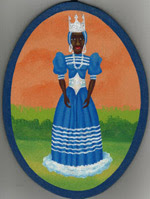
Yemaya, when she punishes, is inflexible, she is a diviner par excellence, she stole Orula's okpele and he then gave her the cowrie shells (diloggún). She is the owner of the waters and the sea, the source of all life. Queen of Abeokutá. Her name comes from the Yorùbá Yemòjá (Yeyé: mother – Omo: child - Eyá: Fish) literally mother of fish. It is said that we are all her children, because for 9 months we swim like fish in our mother's placenta. She always eats with Shango, except Yemaya Okute who eats with Oggun.
She is received as a tutelary Orisha and in the Sodo Orisha her Omo do not receive Oyá. Before settling her, a ceremony is performed in the sea at least 7 days in advance and her Otá are 7 dark or black stones collected there. In syncretism, she is compared to the Virgin of Regla (September 7). Her number is 7 and its multiples. Her color is blue and its shades. She is greeted with ¡Omío Yemaya Omoloddé! ¡Yemaya Ataramawa!
Yemaya's Family.
Daughter of Olokun, which is why she is associated with the sea, she was the wife of Obbatala, Orunla, Aggayu, Babalu ayé, Orisha Oko and in one of her paths of Oggun. Sister of Oshún. She was the mother of most Orishas and raised the others.
Diloggún in Yemaya.
Yemayá speaks in the diloggún primarily through Oddí (7), although she also does so through Irosso (4).
Yemaya's Tools.
 Her receptacle is a blue or bluish porcelain tureen or jar containing the otá and living in seawater. Yemayá's attributes are 7 oars, 7 manillas (bracelets), a crown, a rudder, boats, seahorses, fish, shells, corals, a sun, a full moon, 1 hand of cowrie shells, a mermaid, plates, a lifebuoy, a star, a key, a blue-painted maraca, round fans, a pilón (mortar), and everything related to the sea made of iron, silver or silver-plated. Her most traditional Elekes are made by interspersing blue and white beads or 7 blue beads, 1 ultramarine blue and 7 water-colored beads.
Yemaya's Power Objects.
Yemayá's power object is an agbegbe, a duck or peacock feather fan decorated with mother-of-pearl and shells. An object made with horse tail hairs with blue and white beads. A bell that is rung to call her.
Yemaya's Attire.
Yemaya wears a crepe mantle with a navy blue dress, which may have blue and white adornments. She has small bells sewn onto it. She carries her agbegbe. A wide cotton belt with a rhomboid over her stomach around her waist.
Yemaya's Dances.
When Yemaya descends, she arrives laughing loudly. Her body moves like the ocean waves, gently at first, then agitated by the storm. She then begins to spin like a whirlwind. She can imitate swimming or diving in the ocean bringing treasures from the bottom for her children. She can also imitate rowing. The other dancers form a circle around her, making movements like waves that increase in speed until they begin to spin.
Offerings to Yemaya.
She is offered Ochinchin de Yemaya made from shrimp, capers, lettuce, hard-boiled eggs, tomato and Swiss chard, ekó (corn tamale wrapped in banana leaves), olelé (black-eyed peas or cowpeas made into a paste with ginger, garlic, and onion), green plantains in balls or yam with okra, black beans, gofio patties with sugarcane molasses, burnt coconut, black sugar, whole fish, watermelon, pineapples, papayas, grapes, water pears, apples, oranges, sugarcane molasses, etc. She is sacrificed rams, ducks, chickens, Guinea fowl, doves, quails, geese. Her Ewe are royal itamo, lettuce, white peregun, atiponlá, marjoram, mazorquilla, blackberry, water flower, wild melon, indigo herb, watercress, verbena, malanguilla, paragüita, prodigiosa, fern, cockroach, malanga, canutillo, basil, peppermint, buttercup, hierba de la niña, carqueja, diez del día, crab vine, male ubí vine, bitter vine, purslane, jagua, sea silt, avocado, plum, pichona, mountain copalillo, etc.
Coronating Yemaya. Kari-Osha.
To coronate this Osha, the Warrior Orishas must have been received first. Then during the coronation, the following Oshas and Orishas must be received: Elegguá, Obbatalá, Oke, Yemaya, Ibeyis, Shangó, Ogué and Oshún.
Yemaya's Paths.
Her paths are:
- Yemaya Asesu.
- Yemaya Awoyó.
- Yemaya Akuará.
- Yemaya Okute or Okuti.
- Yemaya Ibu Konla.
- Yemaya Ashaba or Ayabá.
- Yemaya Mayaleo or Mayelewo.
- Yemaya Yembó or Yemú.
- Yemaya Ibu Okoto.
- Yemaya Ibu Oleyo.
- Yemaya Ibu Elowo.
- Yemaya Akere.
- Yemaya Oro.
- Yemaya Ataremawa.
- Yemaya Ibu Gunle.
- Yemaya Ibu Agana.
- Yemaya Ibu Akinomi.
- Yemaya Ibu Iña.
- Yemaya Oggún Ayipo.
- Yemaya Oggún Asomi.
- Yemaya Ibu Nodo.
- Yemaya Yamase.
- Yemaya Ibu Alaro.
- Yemaya Ibu Yabani.
- Yemaya Ibu Tinibu.
- Yemaya Lokún Nipa.
Characteristics of Omo Yemaya.
The children of Yemaya are willful, strong, and rigorous. At times they are impetuous, arrogant, and maternal or paternal, with a changing character like the sea, sometimes calm and sometimes wild. Men are often effeminate and have feminine attitudes and should be careful not to be mistaken for homosexuals. They like to test their friendships, they resent offenses and never forget them, even if they forgive them. They love luxury and magnificence. They are fair but a little formal and have a high degree of self-esteem.
Yemaya's Patakis.
Yemaya was married to Orula, a great diviner of Ifé, who performed miracles and had a large clientele. At that time, Orula was intimately connected to the secret of the cowrie shells (Diloggun), as Yemaya, owner of the sea, fish, cowrie shells, and everything marine, communicated it to him. He, in turn, interpreted these secrets through the Oddun and the legends. It happened that one day Orula had to make a long and tedious journey to attend a meeting of the Awó convened by Olofin, and as he delayed more than Yemaya imagined, she was left without money, so she decided to apply her technique and wisdom to consult on her own those who needed help. When someone came to seek Orula for a consultation, she told him not to worry and cast the Diloggun. As she was a diviner by birth, her predictions were very successful and her ebboses saved many people. Orula, on his way home, heard that there was a diviner and miraculous woman in his town. Curious - like all human beings - he disguised himself and, asking for the place where that woman lived, arrived at his own house. Yemaya, upon discovering him, said: "And what did you think, that I was going to starve?" So he, enraged, took her before Olofin, wise among the wise, who decided that Orúnmila would consult with the okpele, the ikines, and the Até de Ifá, and that Yemaya would dominate the Diloggun. But he warned Orula that when Yemaya appeared in his Oddun, all the Babalawos would have to pay homage to her, touch the board with their forehead and say: Ebbo Fi Eboada.
 English
 French
 German
 Italian
 Russian
 Spanish